
Many start-up entrepreneurs take two to three years before they draw a consistent wage or salary from their business. But the timeline varies significantly based on the industry, initial investment and market conditions.
For the beef industry, the timing of when you enter the cattle cycle can have a significant impact. This is often called the “sweat equity” period when you are foregoing current income with the expectation that future earnings will occur.
However, even after this initial phase, many operations, particularly those that are family-based, rely heavily on unpaid labour — often from aging family members or those working off-farm — which can mask the true cost of production. At this point, an operation must ask: Are they building equity or just sweating?
Read Also
Coronavirus vaccine reduces respiratory disease treatments in beef calves
A clinical trial on 887 calves tested whether intranasal bovine coronavirus vaccination at birth could reduce respiratory disease treatments.
The cost of labour on cow-calf operations
Total labour costs — both paid and unpaid — represent a significant portion of cow-calf total production costs (cash, depreciation, opportunity costs). On average, labour accounts for 17 per cent of the total production costs, with a range from five to 34 per cent. This highlights the substantial impact that labour (comprised of hours per cow and wages) has on the profitability and viability of cow-calf operations. Accurately tracking and valuing both paid and unpaid labour is essential for making informed financial decisions, enhancing labour efficiency and improving overall financial performance. The Canadian Cow-Calf Cost of Production Network examined the relationship between herd size, calving season, profitability, wages and overall labour costs.
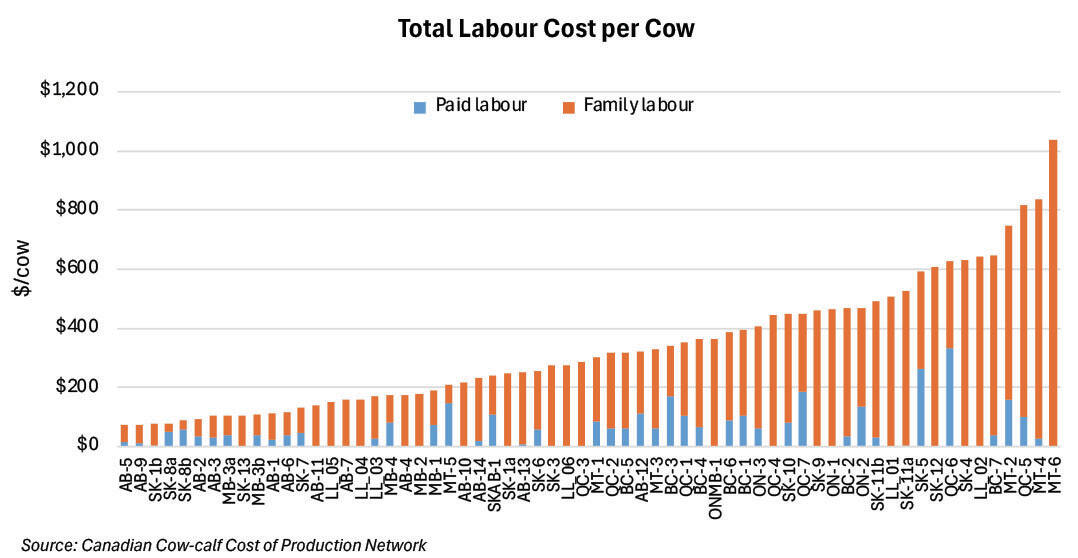
Total labour costs averaged $333 per cow, with 15 per cent (or $51) attributed to paid labour and 85 per cent (or $282) to unpaid labour. Labour costs varied significantly, ranging from $73 to more than $1,000 per cow. The lower end of the range is associated with larger herds or farms that purchased all or a portion of their winter feed, reducing the labour required for forage production. However, this comes with the tradeoff of higher feed purchasing costs. Conversely, farms at the higher end of the labour cost spectrum are driven by more labour hours associated with small herds and/or have a longer calving window.
Labour costs also vary by profitability group, following a pattern similar to labour intensity (hours per cow). Low-profit farms have an average labour cost of $530 per cow, while medium-profit and high-profit farms report significantly lower average costs of $328 and $143 per cow, respectively. The difference in their means, for each of these groups, is statistically significant.
Note: The benchmark farms were divided into low-, medium- and high-profit groups based on long-term profitability (to include unpaid labour). Long-term profitability is revenue minus total production costs including cash cost, depreciation, unpaid labour, and opportunity cost on land and capital.
“At this point, an operation must ask: are they building equity or just sweating?”
Wage
Sometimes, annual wages assume the business is also providing other perks, such as housing, vehicles, insurance, etc. These non-monetary payments should be clearly understood as part of the “total wage” with a value put on them. Without this, cash wages are not comparable to off-farm wages.
Paid and unpaid labour wages averaged $22 per hour in 2024, with a wider range for unpaid labour. Unpaid labour wages were estimated by asking producers what it would cost to hire someone to perform the same tasks.
However, it is important to note that many producers do not consistently track their own labour hours, making it challenging to assign a precise value to their work. Additionally, producers often find it difficult to quantify the value of their own labour, as it involves a blend of managerial, operational and hands-on tasks that are not easily comparable to market wages. This subjectivity can introduce variability in labour cost estimates, particularly for unpaid labour.
Labour hours
Labour intensity averaged 15 hours per cow, with a broad range from 2.8 to 43.3 hours. In comparison, a 2018 USDA study, based on the Agricultural Resource Management Survey, reported an average of 19.2 total labour hours per cow, including both paid and unpaid labour. A possible factor contributing to the lower labour intensity in the COP Network is its larger average herd size. The COP Network’s average herd size is 202 head, compared to 100 head in the U.S. study.
Beef cattle operations rely heavily on unpaid labour, with 83 per cent (12.6 hours) of total labour being unpaid and only 17 per cent (or 2.6 hours) being paid labour. Close to one-third of benchmark operations reported having no paid labour at all. This indicates that labour hours or labour cost primarily translates into opportunity costs for the producer. A key question, therefore, is whether the business generates enough income to compensate the operator for the unpaid hours they put into the farm.
Herd size
Economies of scale are a major driver, where operations with fewer than 50 cows invest an average of 25 hours per cow, while herds of 500 or more cows averaged three hours per cow. Similar trends are observed in the USDA study, with labour hours dropping from 43.7 hours per cow on farms with 20 to 49 cows to just 7.2 hours on farms with more than 500 cows. This consistency across studies reinforces the impact of herd size on labour intensity.
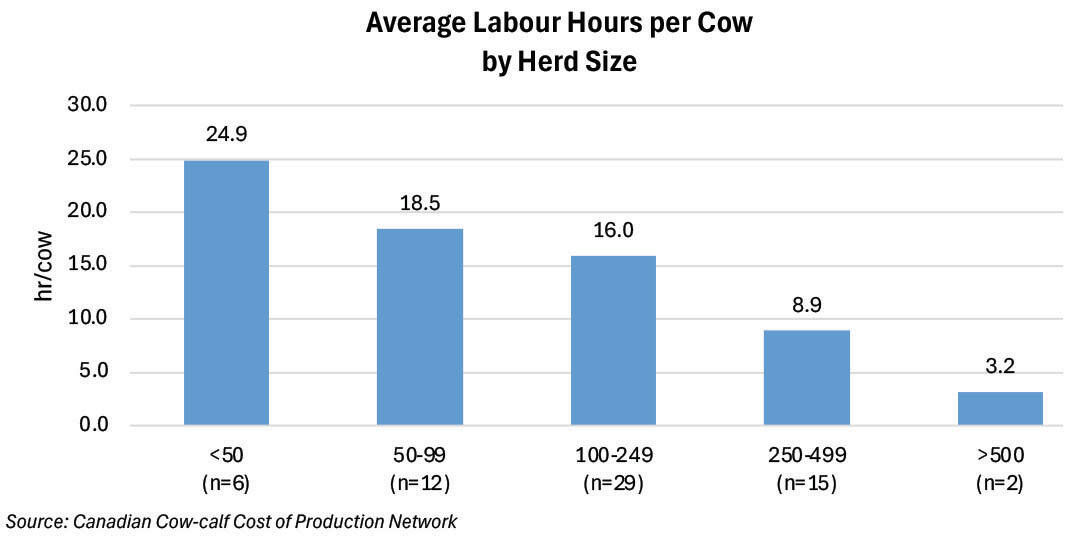
Many tasks such as developing a herd health management plan, gathering animals to move to corrals or rotate between pastures, and working on herd records frequently take a similar amount of time regardless of herd size, or only modestly more for larger herds. In addition to spreading time over more animals, larger herds may also adopt more streamlined processes, utilize specialized equipment and distribute labour more efficiently. Producers expanding their herds must also consider infrastructure capacity, labour availability and management complexity.
Labour intensity by calving season
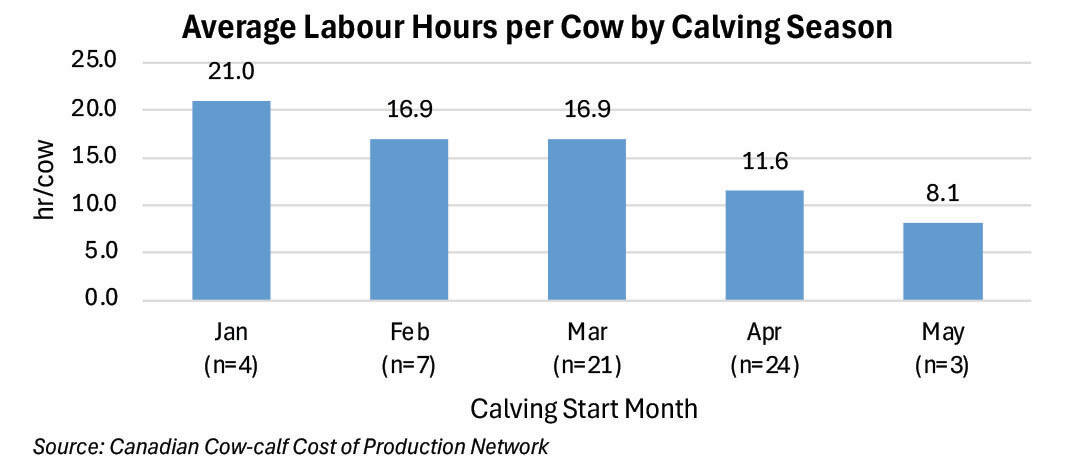
Labour intensity can be influenced by the calving season, as different seasons require varying levels of management. According to Manitoba Agriculture, total labour requirements are highest for winter-calving operations. Fall-calving operations require approximately 10 per cent less labour, spring-calving operations 20 per cent less and summer-calving operations about 25 per cent less.
The COP Network data shows a general downward trend in labour requirements from January to May calving. Some benchmark farms in the COP Network calve in June, September, or both spring and fall. However, these groups are too small to be representative and are therefore excluded from this analysis.
Reducing labour intensity can enhance profitability
The difference in the hours per cow, for the low-, medium- and high-profit groups, was statistically different, suggesting that more profitable operations achieve greater efficiency, likely due to factors such as improved herd management, economies of scale, better infrastructure or the adoption of labour-saving technologies.
Reducing labour intensity can enhance profitability by lowering overall production costs and allowing producers to allocate time and resources more effectively. However, labour efficiency alone does not guarantee higher profits; other factors such as herd size, management practices, market conditions and input costs also play a role in overall financial performance.

Strategies to reduce labour
- Simplify feeding and watering: For smaller herds consider providing multiple days of feed at once. Evaluate how many times winter feed is handled (e.g., swathing, raking, baling, hauling, stacking, etc.) and identify ways to minimize this. Consider the alternative cost and options (e.g., water development) compared to hauling water to remote pasture locations.
- Streamline calving management: implement a tighter calving season. Use herd sires with calving ease to reduce the need for interventions.
- Develop a flexible but clear grazing plan: reduce scouting or “guessing” where to move cattle to next. Consider where permanent cross-fencing would help save time.
- Combine tasks: for example, processing all cattle at once versus individually.
- Train cattle for low-stress handling: make the experience less stressful for both the cattle and people. Cull problem cattle that are repeat offenders (e.g., poor mothering, bad temperament).
- Record-keeping: develop a system (e.g., spreadsheets, management app) that allows you to enter the date once, then be able to utilize it for decision-making. Minimize multiple data entry points.
Key takeaways
- Labour costs represent a significant portion of production expenses (cash, depreciation, opportunity).
- Labour intensity averages 15 hours per cow, with significant variation based on herd size and management practices.
- Larger herd sizes benefit from economies of scale, reducing labour hours per cow.
- Higher profitability is associated with lower labour intensity (less hours per cow).
- Accurately tracking and valuing of both paid and unpaid labour is necessary for making informed financial decisions, enhancing labour efficiency and improving overall financial performance.
- If using sweat equity as part of a succession plan, deferred wages should be calculated into your balance sheet to determine the true profitability of the ranch and transparently value that work. This can help you avoid misunderstandings down the road.
Canfax is funded by membership. Subscribe here.
Disclaimer/Copyright Notice: Canfax Research Services (CRS) tries to provide quality information, but we make no claims, promises or guarantees about the accuracy, completeness or adequacy of the information. CRS does not guarantee and accepts no legal liability arising from or connected to, the accuracy, reliability or completeness of any material contained in our publications. Reproduction and/or electronic transmission of this publication, in whole or in part, is strictly forbidden without written consent from CRS.