

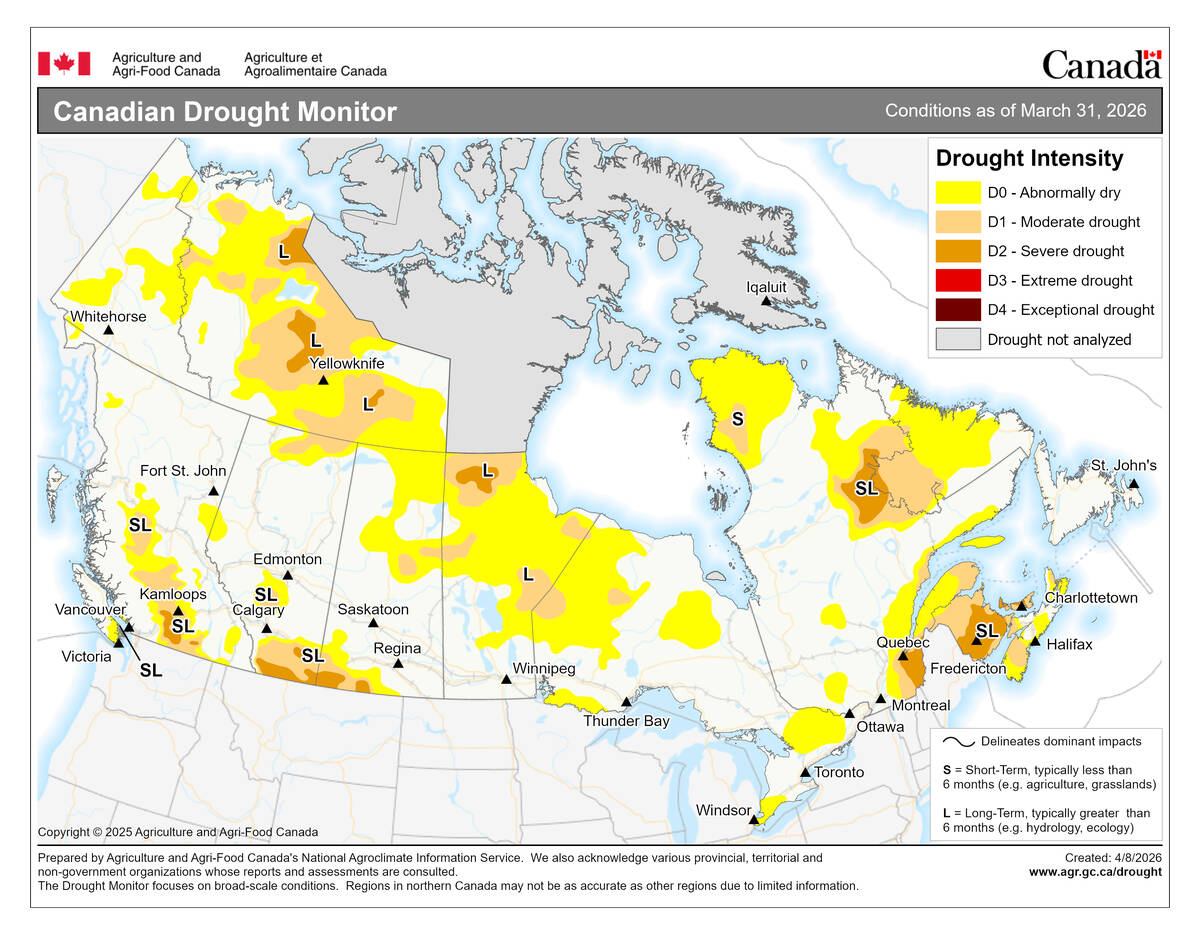
Glacier FarmMedia – The amount of Canadian agricultural land facing drought has been nearly halved after normal to above normal precipitation in March as per the latest Canadian Drought Monitor data from Agriculture and Agri-Food Canada.
The amount of agricultural land facing drought fell to 32 per cent from 60 per cent. At the same time a year ago, an estimated 37 per cent of the country’s agricultural land was facing drought.
Read Also
AAFC projects tighter canola stocks for 2026-27
Canadian canola carryout supplies at the end of the upcoming 2026-27 marketing year will be tighter than earlier projections, according to updated supply and demand estimates from Agriculture and Agri-Food Canada, released April 17.
At the end of March, an estimated 39 per cent of the country was classified as abnormally dry, or in moderate to severe drought, which was down from 53 per cent the previous month, AAFC said in the April 13 report.
WHY IT MATTERS: The improving conditions bode well for Canadian farmers in the areas that received moisture as spring planting and seeding approaches.
Large portions of central British Columbia, northern Alberta, central Saskatchewan and parts of Ontario and western Quebec recorded more than twice the normal March precipitation. However, above normal temperatures and below normal precipitation in southern Alberta and southwestern Saskatchewan continued to reduce soil moisture and increase the extent and severity of drought.
Drought conditions throughout much of Eastern Canada improved significantly with continued above normal precipitation and near normal temperatures. Some portions of central Ontario saw a two-class drought improvement in March.
Only 21 per cent of Prairie farmland in drought
Most of the Prairie region experienced near to above-normal March precipitation, with much of region receiving between 85 and 150 per cent of normal, with some localized areas exceeding 200 per cent of normal due to multiple winter storms. Southern Alberta remained dry with portions of the region receiving less than 60 per cent of normal precipitation and warmer than normal temperatures, resulting in continued expansion of drought.
Snowfall from repeated winter storms increased snowpack, particularly in Alberta, although periodic warming led to some snowmelt in southern areas. Overall, above-normal precipitation supported short-term moisture improvements in parts of Alberta and Saskatchewan, while precipitation deficits persisted in Manitoba, limiting recovery.
At the end of the month, 39 per cent of the Prairie was classified as abnormally dry, or in moderate to severe drought, which compares with 58 per cent the previous month. Only 21 per cent of the region’s agricultural landscape was abnormally dry or facing drought which compares with 47 per cent at the end of February and 32 per cent a year ago.
-Updated April 16