
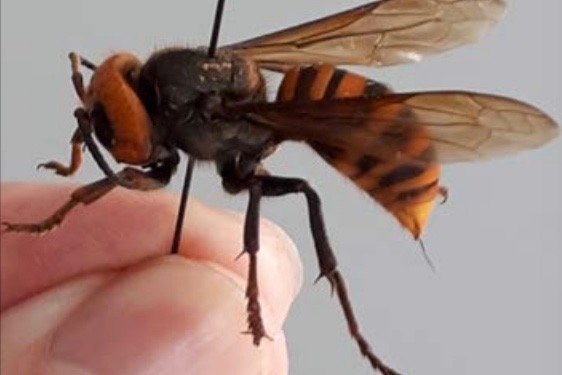
Asian giant hornets have noticeably large orange heads and black eyes; worker hornets are about 3.5 cm in length; queens can be up to four to five cm in length, with a wingspan of four to seven cm. (B.C. Ministry of Agriculture)

More ‘murder hornets’ found in B.C., Washington

Findings suggest some were able to overwinter

Reuters/Staff — Officials in British Columbia and Washington state have confirmed new sightings of the Asian giant hornet, dubbed the “murder hornet,” indicating the invasive, predatory insect survived the winter in the Vancouver area and U.S. Pacific Northwest. The stinging hornet, whose queens can grow as large as 2-1/2 inches in length, could potentially pose […] Read more
(Photo courtesy Canola Council of Canada)

Neonic-treated canola not an ‘unacceptable risk’ for pollinators

Already facing federally mandated phase-outs from many major on-farm uses in Canada over risks to aquatic insects, neonicotinoids aren’t expected to pose “unacceptable risks” to pollinators when used on canola seed or hothouse vegetables in the meantime. Health Canada said as much Thursday as it released its final re-evaluation decisions for three neonic pesticides — […] Read more


(iStock/Getty Images)

EU nations back ban on all outdoor neonic use

Brussels | Reuters — European Union countries backed a proposal on Friday to ban all use outdoors of insecticides known as neonicotinoids that studies have shown can harm bees. The ban, championed by environmental activists, covers the use of three active substances — imidacloprid, developed by Bayer CropScience; clothianidin, developed by Takeda Chemical Industries and […] Read more

Treated corn seed. (Syngenta.com)

Two neonics set for three-year extensions on registration

Health Canada’s pesticide regulator proposes to allow continued registration for two members of the neonicotinoid family of pesticides, both of which are under heavy scrutiny for their effects on bees and other pollinators. The Pest Management Regulatory Agency on Tuesday issued proposed decisions on clothianidin and thiamethoxam that would extend the products’ existing conditional registrations […] Read more


(Thinkstock photo)

Global study finds trace neonics in much of world’s honey

A study by Swiss scientists has found trace levels of at least one neonicotinoid pesticide in three-quarters of the honey samples it collected from around the world. The study, spearheaded by a team from Switzerland’s Universite de Neuchatel and published in Friday’s edition of the journal Science, was meant to assess “global exposure of pollinators […] Read more

Photo: Muhammad Mahdi Karim.

U.S. bee numbers growing

CNS Canada – Honeybee populations are rising in the United States, turning around a recent trend of declines attributed to a set of factors know as colony collapse disorder. It’s estimated that 84,430 hives were lost to the disorder in the first quarter this year. That’s down 27 per cent from a year earlier. Year-over-year […] Read more


(Scott Bauer photo courtesy ARS/USDA)

Operation Pollinator to create friendly spaces for bees and other pollinators on the Prairies

Syngenta Canada and the Soil Conversation Council of Canada have signed on to a multi-year partnership to promote the dedicated spaces for pollinators on the Prairies. Under the program, farmers can sign up to establish Operation Pollinator sites on their farms. In exchange for converting one to two acres of lower productivity land, the farmer […] Read more


(Photo courtesy ARS/USDA)

France moves toward all-out ban on neonics

Paris | Reuters — French lawmakers approved plans for a total ban on some widely used pesticides blamed for harming bees, going beyond European Union restrictions in a fierce debate that has pitched farmers and chemical firms against beekeepers and green groups. The EU limited the use of neonicotinoid chemicals, produced by companies including Bayer […] Read more