
Are handwritten or “holographic” wills legally valid if they’re etched into unconventional materials? This historic case explores that question.
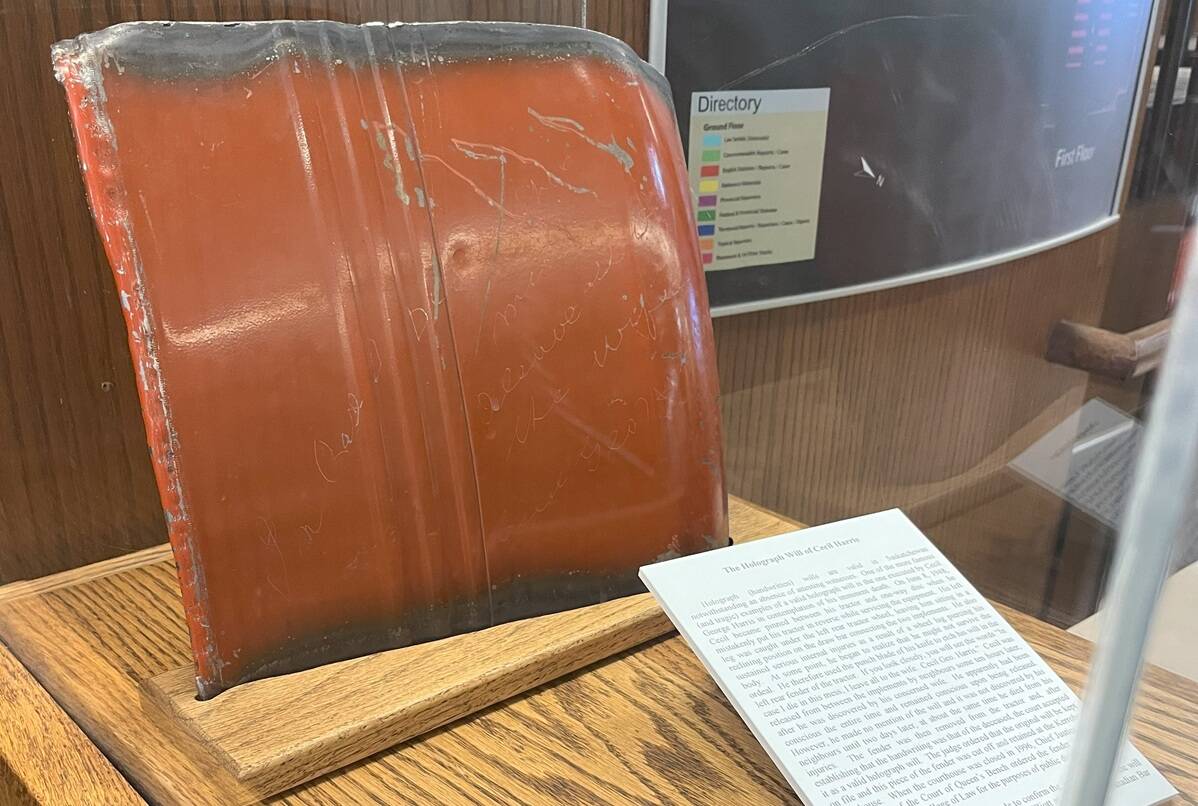
In 1948, Saskatchewan farmer Cecil George Harris was pinned under his tractor after an accident. With little chance of immediate rescue, Harris faced a dire situation. Aware that his time may be limited, he made an extraordinary decision to create a will in an unconventional way. Harris used a pocketknife to scratch his will into the metal fender of the tractor. That act turned into one of the most famous legal cases in Canada.
This story looks at what happened, court involvement and why it still matters to farmers and ranchers in Saskatchewan and across the country today.
Read Also
Sweat equity or just sweat? What labour means for profitability on cow-calf operations
A look at how labour intensity, herd size and calving season shape profitability across Canadian cow-calf operations.
What happened?
On June 8, 1948, Harris became trapped under his tractor while working alone in his field near Rosetown, Sask., during seeding season. While Harris was standing on the ground, the tractor rolled back onto him, knocking him down between the tractor and the one-way plow. A wheel of the tractor pinned down his left leg. It appeared that the one-way plow behind the tractor dug in and became immobile, temporarily saving his life. This gave him the time to scratch out his famous will.
While he was trapped, Harris worried that he might not survive the accident. He used his pocketknife to scratch a concise will onto the fender of the tractor, writing:
“In case I die in this mess I leave all to the wife. Cecil Geo (sic) Harris.”
Harris remained pinned for approximately 10 hours before he was discovered and taken to the hospital, but he died of his injuries the following day.
A couple of days after Harris was first pinned, two neighbours were laying grasshopper poison near the scene of the accident. One of them began to examine the tractor, which had not been moved since it was raised to free Harris. During this examination, the neighbour found the handwritten will scratched into the paint on the left fender.
A local lawyer, William Stanley Elliott, was retained to ensure that the estate of Harris was administered according to the fender will. Elliott skillfully compiled compelling evidence from those who knew Harris, attesting that the handwriting on the tractor fender was indeed from Harris’s own hand. Elliott even engaged a local photographer to make a photographic record of the fender.
Was it valid?
The Harris will was granted letters of administration by the Saskatchewan Surrogate Court on July 13, 1948, a little over a month after the accident. The court clearly accepted that Harris intended to leave all of his property to his wife, Bessie May Harris.
In Saskatchewan, the law required that the original will be preserved on the court file. The surrogate court indeed ordered that the portion of the fender containing the will was to be cut from the rest of the fender and be placed on the court file. The portion of the fender remained at the Kerrobert courthouse until 1997. At that time, it was given to the University of Saskatchewan College of Law, where it was placed on display.
The Harris will was never the subject of a published court decision. Despite this, the will became a famous event shortly thereafter. Numerous North American newspapers commented on this unique will. It was even referenced in a Ripley’s Believe It or Not! column, which was widely distributed in the United States.
What changed?
The Harris will did not result in any legal changes itself. At the time of the Harris will, the Saskatchewan Wills Act, SS 1931 c 34, already recognized the legality of holographic wills, which were entirely made in the handwriting of the deceased.
Rather, the influence of the Harris will stems from its demonstration of the use of holographic wills in certain situations. When people work in hazardous occupations, it is not always possible to make a formal paper-drawn will in the presence of witnesses.
The Harris will demonstrated that existing law relating to holographic wills could be applied to unique situations, including wills written on unconventional mediums. All that was required was convincing evidence that the will was indeed signed by the testator and displayed a clear intention to dispose of the testator’s property on death. The Harris will demonstrated that there were no restrictions on the materials used for the purpose of writing a holographic will.
Meaning for farmers and ranchers
The case of Cecil George Harris’s holographic will holds particular significance for farmers and ranchers who often live and work in remote, hazardous environments.
The Harris will reminds us of the risks that farmers and ranchers face every day, operating in outdoor conditions alongside heavy equipment or large animals.
It shows that farmers may not have time or opportunity to prepare formal wills in traditional circumstances. At the same time, it shows the ingenuity that can be brought to such situations.
Despite his dire predicament, Harris displayed real resourcefulness. Unable to reach paper or get legal help, he used his pocketknife to scratch a clear message on the metal fender of his tractor. This inventive act ensured his estate would be distributed according to his intentions, even without standard legal formalities.
The Harris will is also a reminder of the importance of advance estate planning. While testators can make holographic wills in dire situations, it is preferable to prepare a careful will before such situations arise. A formally drawn will better ensures that you can consider all gifting options and estate planning wishes, and use the proper wording to give effect to the full range of intended gifts.
Ultimately, Harris’s holographic will underscores the importance of accessible and flexible regulations that acknowledge and respect the diverse lived experiences of farmers and ranchers across Canada.
Citations
Ellwand, Geoff. “An Analysis of Canada’s Most Famous Holograph Will: How a Saskatchewan Farmer Scratched His Way Into Legal History” (2014) 77 Saskatchewan Law Review 1. c