


In my previous article, I mentioned that the USDA made a downward revision to the 2019 calf crop while the 2020 calf crop came in lower than expected. Since then, Statistics Canada has also released their cattle inventory report. It appears that western Canadian calf and yearling supplies as of January 1, 2021, were down 3.5 per cent from year-ago levels. I’ve received many inquiries from producers asking how the calf crop compares to historical numbers. Therefore, I thought this would be an opportune time to provide an overview of the Canadian and U.S. feeder cattle supplies. I’ve also provided a historical chart and suggested a price range for the upcoming fall and winter given the supply situation.
The 2020 U.S. calf crop came in at 35.136 million head, down from the 2019 crop of 35.591 million head. This is the second year-over-year decline in calf numbers and we’ll likely see another reduction in 2021. When corn or feed grain prices are very strong, it is unlikely that the U.S. cattle producer will expand the herd.
Read Also
Liver abscesses in cattle cost producers millions each year
Liver abscesses in cattle cause millions of dollars of losses to North American producers each year.

The decision to expand or contract has likely been made at this time of the year. U.S. producers were disappointed with the calf prices during the COVID-19 pandemic. The U.S. cow slaughter in 2020 was marginally higher than in 2019. This liquidation will likely continue into 2021. I’m estimating the 2021 calf crop at 35 million head.
Notice the 2020 calf crop at 35.136 million head is similar to the 2011 output of 35.357 million head. The calves from the 2011 calf crop came on the market during the fall of 2011 and during 2013. Therefore, I want to compare how the market behaved during this time period. I’ve included a monthly chart of the feeder cattle futures where I’ve shown a price range of $150 to $170. This is the projected price range for feeder cattle futures for the fall of 2021 and through 2022. It’s important to remember that during 2012 and 2013, corn futures were readily trading between $6/bu. to $8/bu. At the time of writing the article, December 2021 corn futures were only at $4.75/bu.
Statistics Canada estimated calves on cow-calf and backgrounding operations as of January 1 at 2.430 million head, down approximately 58,000 head from January 1, 2020. If we account for yearlings and calves, the total number of feeder cattle outside finishing feedlots in Western Canada as of January 1 was 2.945 million head, down 3.5 per cent or 107,000 head from year-ago levels. Notice the total number has been declining since 2016.
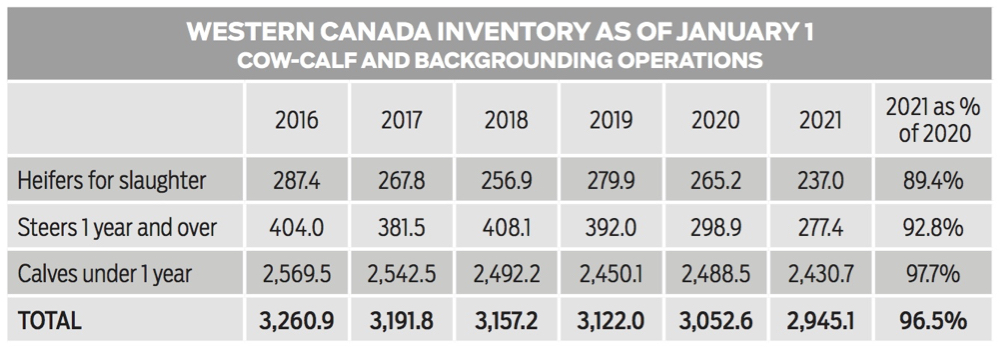
In conclusion, the U.S. calf crop has been contracting for two years and will likely decline again in 2021. In Western Canada, the total number of yearlings and calves under one year has been declining since 2016. Higher corn prices could limit the upside in the feeder market; however, at this stage, the 2021 corn futures suggest that the feed grain fundamentals may not be as tight during the 2021-22 crop year. The projected range for feeder cattle futures during the fall of 2021 and throughout 2022 is in between $150 and $170. At the time of writing this article, the November 2021 feeder cattle futures had been readily trading from $153 to $157, which is on the low side of the projected range.