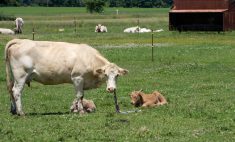



The calving jack can save a life, but it can just as easily kill the cow or calf if used improperly. That’s why it’s important to understand the pros and cons of this tool.
A calving jack can exert up to 400 kg of force. For context, a cow naturally pushing exerts 75 kg of force, while two people pulling on a calf exert 150 kg. While a calf jack may extract a calf when two people manually pulling have failed, the result may be a fatality. Forcing a calf through a birth canal that it should not fit through causes serious trauma to both cow and calf.
WHY IT MATTERS: A calving jack can exert more than five times the force a cow generates on her own. Used at the right time, it saves lives. Used too soon or too aggressively, it causes nerve damage, internal tearing, broken bones, and death — injuries that far outweigh the cost of calling a veterinarian or waiting 20 more minutes.
Risks to the cow
Cows are at risk of nerve damage, which can result in them going down after calving. In some cases, nerve damage is permanent. In others, the cow experiences severe muscle damage from prolonged lying and dies before the nerve recovers. Cows are also at risk of uterine or vaginal tearing from hard pulls. This can lead to peritonitis and death, or reduced fertility in future breeding seasons. In extreme cases, severe pelvic or spinal cord injuries can leave cows completely paralyzed.
Risks to the calf
Read Also
Researchers advance first-of-its-kind bovine TB vaccine to trials
A University of Saskatchewan vaccine candidate for bovine TB has cleared mouse trials and is moving to cattle testing — a potential world first.
Calves are at risk of broken bones, especially ribs and limbs if chains are placed incorrectly, and internal organ damage.
When the calving jack makes sense
A calving jack is a useful tool for mild to moderate dystocias when a person is working alone, especially if they have strength or physical limitations. Before pulling any calf, check to make sure the calf is in the normal birthing position. You should feel a nose and two front feet.
Before pulling, determine if the calf is likely to fit through the pelvic canal. You should be able to fit one hand on either side of the calf’s shoulders as it is entering the canal. If your hand does not fit or if the calf’s front legs are crossing, it is unlikely the calf will fit. Remember, the widest part of the calf is the hips. If the shoulders of the calf are already wedged into the pelvic canal, then the hips can’t make it through.
Why patience matters
Even if the calf is in normal presentation and presumed to fit through the birth canal, the calf jack should not be the first choice of intervention. When a calf is born, the entire process of pushing the calf through the birth canal (stage two of labour) can take 30 minutes to two hours. This allows the cow’s cervix to fully dilate, her vagina to stretch, and facilitates the safer progress of the calf to reduce tearing. A calf jack will expedite the process, preventing the cow’s body from naturally adapting and increasing unnecessary trauma to cow and calf.
“Forcing a calf through a birth canal that it should not fit through causes serious trauma to both cow and calf.”
Dr. Lexie Reed
If a cow or heifer is not progressing after 20 to 30 minutes of active labour, it is appropriate to intervene. There are several techniques that can be used to leverage the cow’s natural physiology during labour as an alternative to the calf jack.
Alternatives to the calving jack
Cervix not dilated
If the calf is unable to fully enter the birth canal because the cervix is not fully dilated, it can be manually dilated. Place your hands through the cervix and clasp them on the uterine side. Push outwards with your forearms to encourage dilation of the cervix. The cervix should slowly dilate as you continue to push for several minutes.
Vagina not dilated
If the cervix is dilated but the vagina is preventing passage of the calf, use the same technique above with your arms to stretch the vagina. This helps to prevent tearing of the perineum, the separation between the vagina and the rectum.
Calf stuck in birth canal
If there is concern that the calf is too large to fit through the birth canal, there are a couple of tips to try before resorting to veterinary intervention. First, apply lots of lubricant. Mix in a bucket and use a drench tube and pump to get sufficient lubrication inside the birth canal. If possible, avoid J-Lube, as this brand is irritating to the abdomen if the dystocia leads to a C-section. Second, cast the cow down so she is lying instead of standing when you pull the calf. When a calf is lying down her pelvis is naturally tilted on a 45 degree angle. Since the birth canal is an oval shape, this rotation allows the hips of the calf to pass through on a diagonal, naturally creating extra space for it to pass.
For in-depth instructions on how to safely and easily cast a cow, search for videos of the Rueff or Burley method for casting cows with rope.
When to stop pulling
Keep in mind that as long as the umbilical cord is intact, the calf is receiving oxygen from the cow, and there is time to perform these manipulations. There is one related scenario where a calf jack is especially useful: backwards calvings with larger calves. When the calf passes through the birth canal backwards, the pelvis puts pressure on the umbilical cord, limiting oxygen delivery to the calf. If the calf runs out of oxygen, its instinct is to inhale, and it may breathe amniotic fluid into its lungs. Once the decision has been made to pull the calf, it is important to get the calf’s hips and abdomen through the pelvic canal as quickly as possible to prevent this.
If progress is not being made after 20 minutes, move on to the next option. Some calvings will only end successfully in a C-section or fetotomy. Making this decision promptly will improve the success rate for both calf and cow.