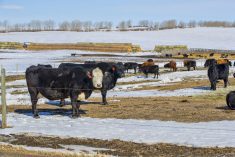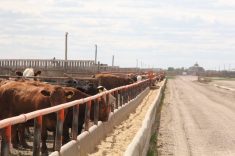


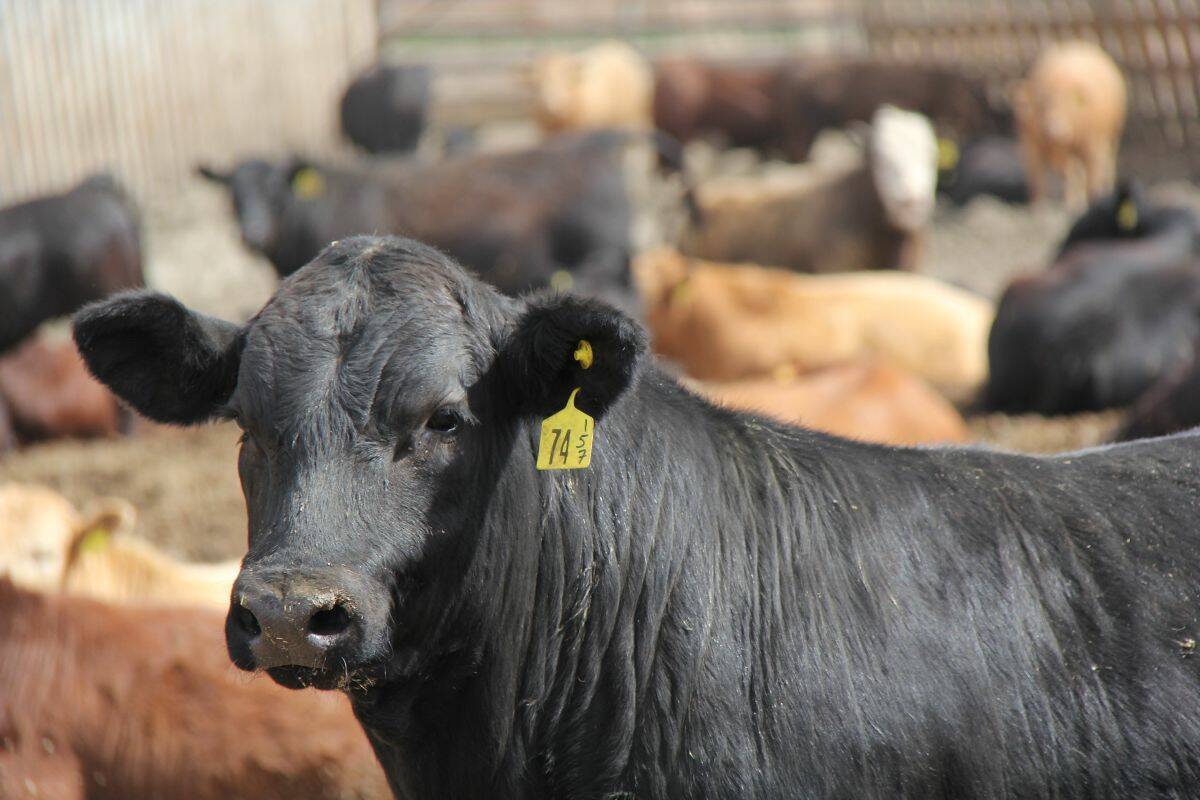
I’ve received many calls from feedlot operators over the past month regarding the fed cattle market. During the last week of September, Alberta packers were buying fed cattle on a dressed basis in the range of $520-$525/cwt. Sales direct free-on-board at the feedlot in southern Alberta were quoted at $312/cwt. The concern from feedlot operators is that the replacements that came into the feedlot during September don’t pencil out. The main question is will we see live cattle futures and the Alberta cash market rally significantly between now and the spring of 2026 so that feedlot margins remain in positive territory.
In the short term, U.S. fed cattle supplies are actually quite burdensome. U.S. cattle on-feed 150 days or longer as of September 1 were 1.243 million head, up 47 per cent or 399,000 head from September 1, 2024. U.S. steer weights are up 20 pounds from last year and up 36 pounds from two years ago.
The western Canadian situation is better from a fundamentals standpoint. Cattle on-feed 180 days or more as of September 1 in Alberta and Saskatchewan totalled 164,458 head, up 4.4 per cent or 6,935 head from 12 months earlier. Cattle on-feed 150 days or more came to 290,870 head, down 1.3 per cent from September 1, 2024. Dressed processing weights in Western Canada are similar to year-ago levels. There has been no buildup of market-ready cattle in Western Canada.
Read Also
CCA charts industry-led path on traceability after rejecting federal proposal
After rejecting proposed federal traceability regulations, CCA and provincial organizations will pursue an industry-led, risk-based approach to disease preparedness.
In the U.S., the packers have purposely curtailed the slaughter pace to try to keep wholesale beef prices at higher levels. This paid off significantly during the summer. However, wholesale choice beef at the end of September was valued at US$370/cwt, down about US$40/cwt from mid-August. Wholesale beef prices are trending lower. Fed cattle prices have been holding value so far, but we’ll likely see softer values later in fall.
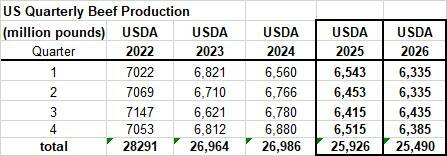
In the following table, we have U.S. quarterly beef production estimates. U.S. beef production during the first quarter of 2026 is expected to be down 208 million pounds from a year earlier. Second quarter output is expected to be down 118 million pounds from the second quarter of 2025.
Stronger demand has contributed to the higher beef prices. U.S. away-from-home and at-home food spending has been running sharply above year-ago levels. For regular readers of Canadian Cattlemen, you know that a one per cent increase in consumer spending equates to a one per cent increase in beef demand. U.S consumer spending is about 66 per cent of U.S. GDP. Cattle producers must watch U.S. GDP because this is a large contributor to fed cattle market direction.
I’ve included U.S. and Canadian GDP forecasts. U.S. GDP for the second quarter of 2025 came in at 3.8 per cent. The Federal Reserve Bank of Atlanta’s GDPNow economic model has third-quarter GDP at 3.9 per cent. This is considered stellar growth. The key is that U.S. fourth-quarter GDP is only expected to come in at two per cent and the 2026 first-quarter GDP is expected to drop to 1.5 per cent.
I’ve also included a weekly chart of the live cattle futures. I’m using 2023 and the first half of 2024 as an example. In the third quarter of 2023, U.S. GDP came in at 4.9 per cent and this was a new historical high at that time. U.S. fourth-quarter GDP came in at 3.2 per cent and then remained under two per cent for the first half of 2024. Despite the lower beef production in the first quarter of 2024, the live cattle market did not make a fresh high.
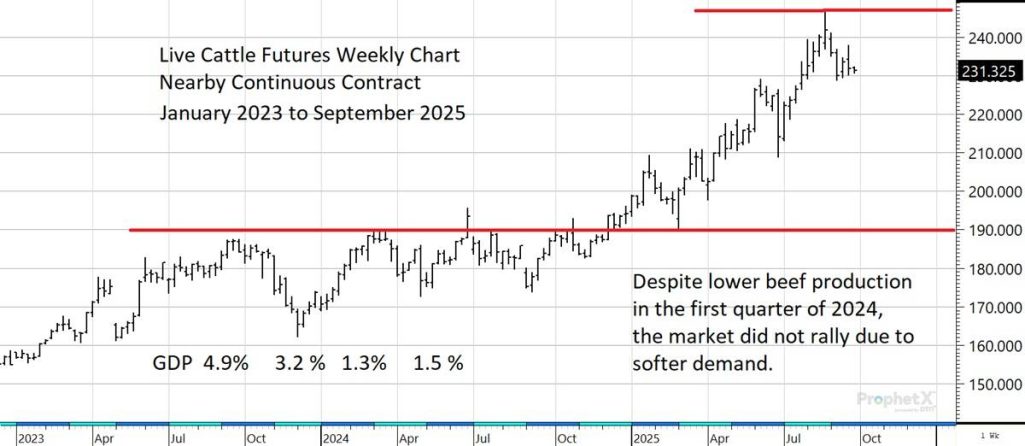
The market in the latter half of 2025 and first half of 2026 is shaping up to be in a similar environment to 2023 and 2024. The pace of U.S. economic growth and consumer spending is forecasted to be slow in the final quarter of 2025 and the first half of 2026. Despite lower beef production, the market will not rally in the first quarter of 2026 due to softer demand. Longtime subscribers know this also occurred in the fall of 2014 and the first half of 2015. GDP softened and despite a year-over-year decline in beef production, the market did not make fresh highs. This is the third time in the past 10 years we are seeing this market environment. Therefore, take note! Don’t bank on significantly higher fed cattle prices in the first half of 2026. Demand won’t be there to push the market higher. c